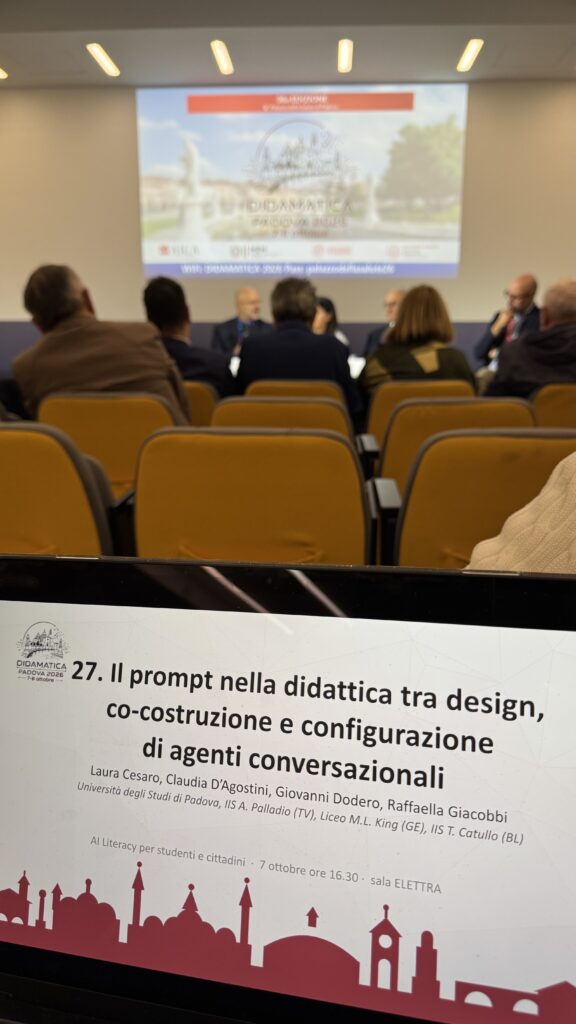
On October 7th, our paper “Il prompt nella didattica tra design, co-costruzione e configurazione di agenti conversazionali” (Prompting in Education: Design, Co-construction and Conversational Agent Configuration) was presented at DidaMatica 2026 in Padova, during the session dedicated to AI literacy for students and citizens.
Co-authored with Claudia D’Agostini, Giovanni Dodero, and Raffaella Giacobbi, the work grew out of a collaboration that began during our time in the Équipe Formative Territoriali (EFT). It brings together four educational experiences developed in very different contexts: a hackathon, a curricular laboratory, a summer remedial course, and a teacher training programme.
Together, these experiences show how prompting is not simply a technical skill, but a pedagogical practice whose role changes depending on who uses it, for what purpose, and at what stage of the learning process.
In HackinGPT, students designed their projects before interacting with AI, making prompting the outcome of a design process rather than its starting point. In Visual Lab, an activity I helped develop within the Erasmus+ AI2Schools project, students used AI to co-construct interactive simulations in mathematics and statistics, learning through an iterative process of creating, testing, evaluating, and refining. The other two experiences explored the configuration of conversational agents: an AI tutor designed to guide students without simply providing answers, and a teacher training activity where configuring an agent became a way to make implicit pedagogical knowledge explicit.
Designing, co-constructing, configuring: three different functions of prompting that highlight the importance of pedagogical choices over technical skills alone.
A special thanks to my co-authors for bringing these different perspectives together, and to Claudia for presenting our work at the conference.