At ITADINFO 2026, the fourth Italian Conference on Computer Science Education, this year held in Padova, I contributed to two sessions exploring how educational robotics can make programming and artificial intelligence more accessible through hands-on learning experiences.
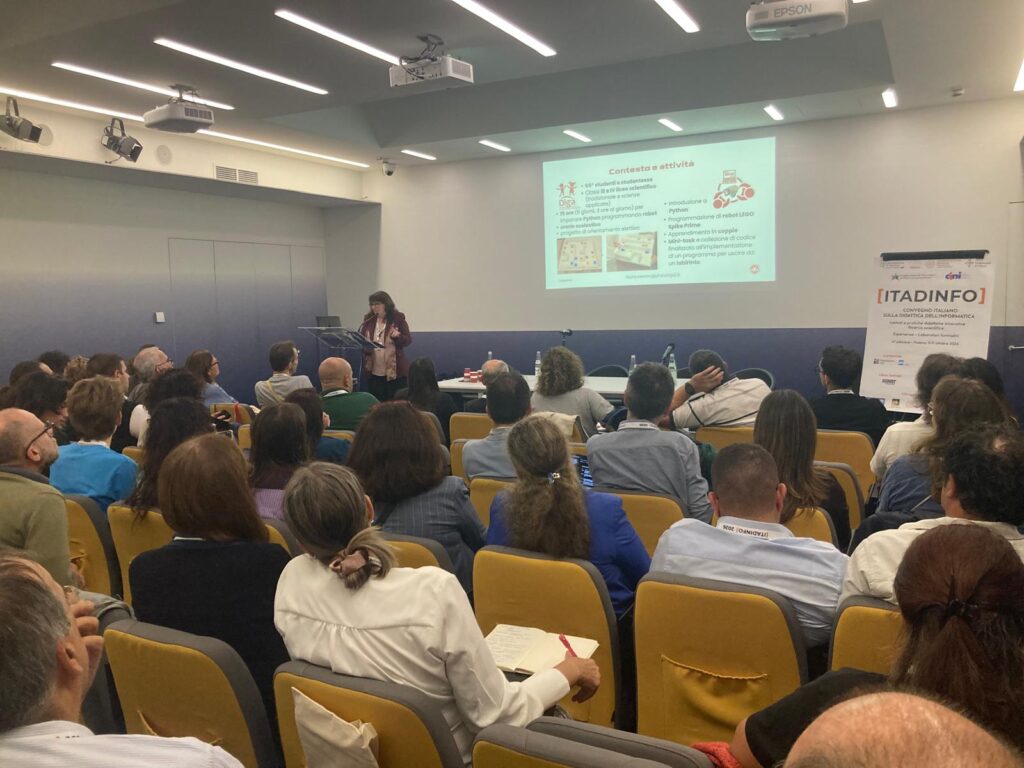
On October 9th, I presented “Dal codice all’azione: imparare Python con i robot” (From Code to Action: Learning Python with Robots), co-authored with Emanuele Menegatti. The contribution presented the results of a 15-hour course involving 55 upper secondary school students who learned Python by programming LEGO SPIKE Prime robots.
The study explored how robotics can support the learning of text-based programming, making the relationship between code and its effects visible and tangible. Results showed significant improvements in students’ perceived programming competence, alongside a shift towards more technical and realistic representations of robots. However, gender stereotypes remained largely unchanged, suggesting that short educational interventions, while valuable, are not enough to overcome deeply rooted beliefs.
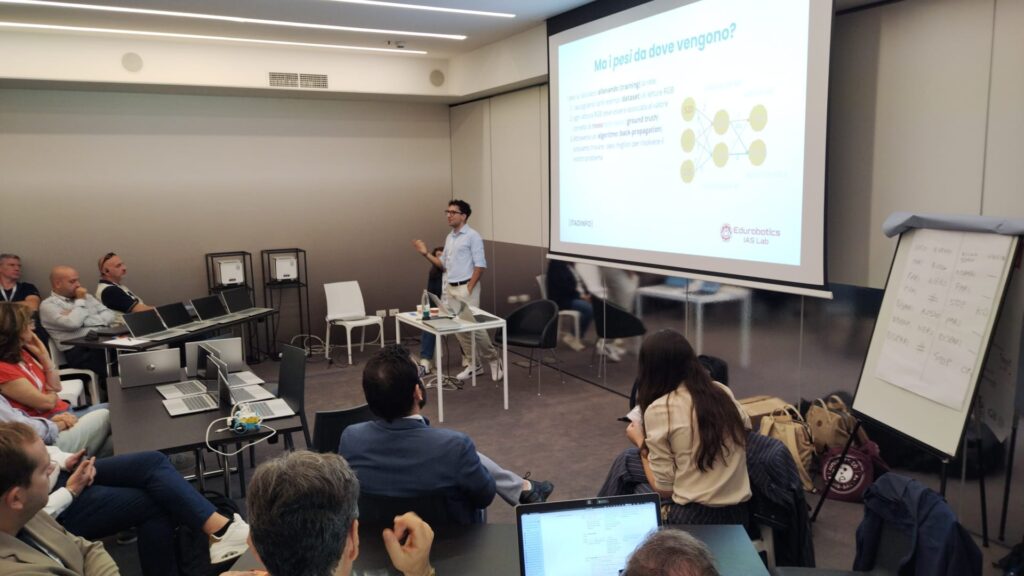
On October 10th, together with Daniel Fusaro, I led the hands-on workshop “Questo colore non c’è sui blocchi!” (Teaching a Robot to recognise new colours with Machine Learning). Participants explored how to extend the capabilities of a LEGO SPIKE Prime robot by collecting data from its colour sensor, training and evaluating a neural network, and using the resulting model directly on the robot.
The two contributions approached educational robotics from complementary perspectives: using robots to make programming more concrete, and using programming to make artificial intelligence understandable. Both reflect an approach in which students and teachers learn by experimenting, observing results, and refining their solutions.