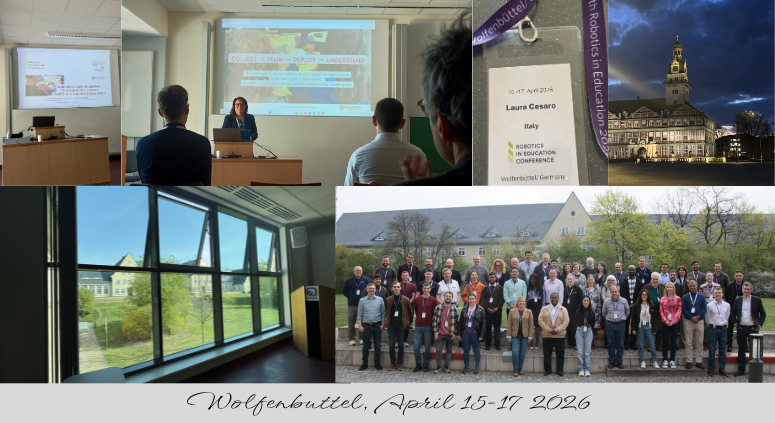
In April 2026, I took part in the 17th International Conference on Robotics in Education (RiE 2026), hosted by Ostfalia University of Applied Sciences. After my first experience as an international conference speaker at RiE 2024 in Koblenz, returning to RiE represented a meaningful step in my doctoral journey, allowing me to present a more developed stage of my research and to continue the dialogue with the international educational robotics community.
During the conference, I presented an educational activity centred around a simple but engaging question: Can a robot learn to recognize colours it has never seen before? Starting from this challenge, middle-school students collected data from the robot’s colour sensor, trained and evaluated a neural network directly on a LEGO SPIKE Prime robot, and finally deployed the model to extend the robot’s capabilities beyond its built-in colour recognition system.
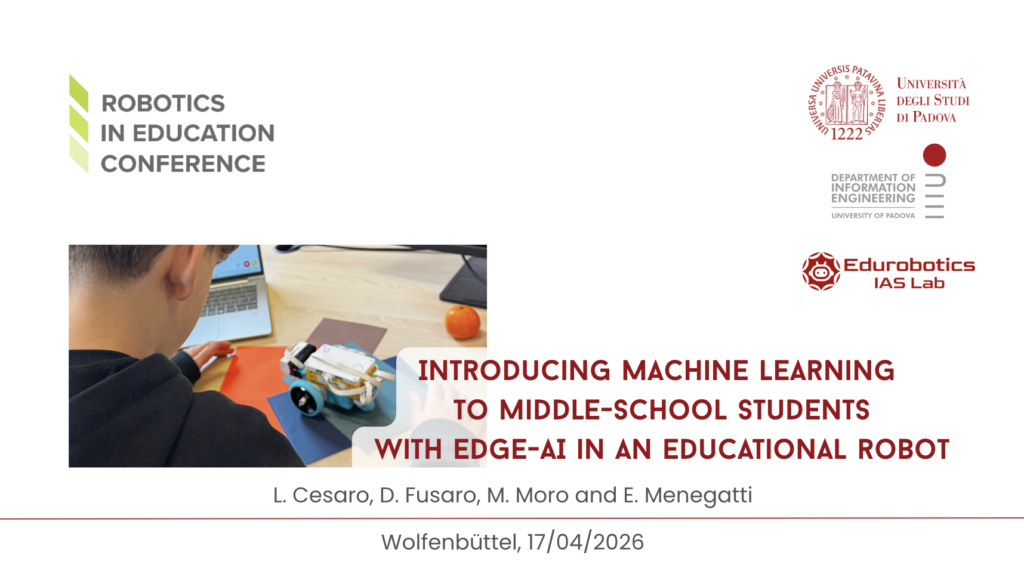
Rather than using Artificial Intelligence as a ready-made tool, students experienced the entire machine learning process firsthand, discovering how a robot can “learn” from data and how its behaviour depends on the quality of the training process. A distinctive aspect of the activity was that the complete machine learning pipeline, from data collection to model deployment, was executed directly on the robot, making AI tangible, transparent, and accessible.
This work was accompanied by a second paper from our research group, focusing on the engineering aspects behind the activity. While one paper explored the educational design, students’ learning experience, and its educational evaluation, the other introduced µ-learn, a lightweight on-device machine learning library led by my colleague Daniel Fusaro, which enabled the entire machine learning pipeline to run directly on the LEGO SPIKE Prime robot. Together, the two contributions document both the pedagogical and technical dimensions of the same research project, highlighting how educational and engineering research can evolve hand in hand.
Together, these two papers capture the complementary dimensions of the same research project: the educational design of an AI learning experience and the engineering work required to make it possible. RiE 2026 was a valuable opportunity to discuss both perspectives with the international Robotics in Education community and gather ideas for the next steps of this research.