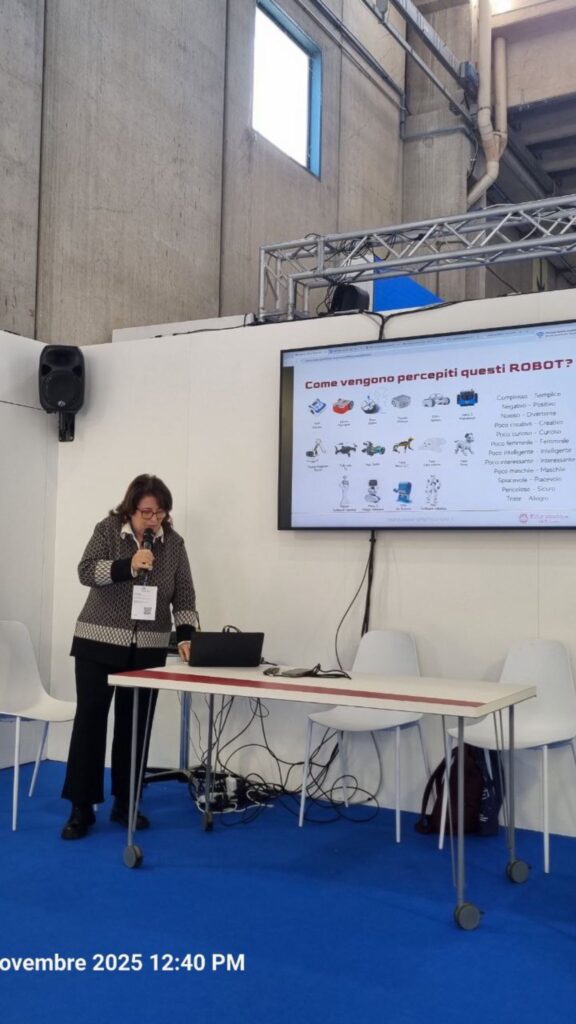
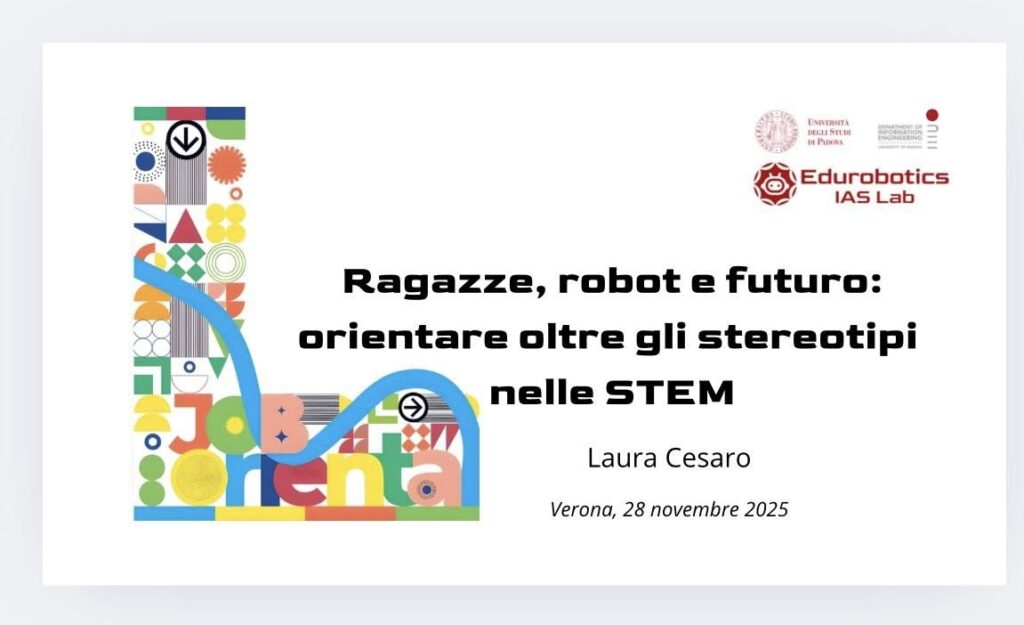
On November 28th, as part of Job&Orienta 2025, the national fair on orientation, education and work held in Verona, I led a workshop organised by USR Veneto titled “Girls, robots and the future: orienting beyond stereotypes in STEM“.
The starting question: why do girls choose STEM pathways less often than boys? The workshop explored how narratives, stereotypes and representations continue to shape dreams and choices, and how educational robotics can become a starting point for more conscious and inclusive orientation practices. Exploring the language and imagery that surrounds technology means understanding how to act with greater awareness in educational settings.
Orientation is not just about helping students choose. It is about creating the conditions for every student, girls and boys alike, to be able to picture themselves in futures they may not yet see as available to them.
This involves everyone. Teachers, who need to recognise that expectations, language and pedagogical choices can open or close opportunities. Girls, who need to know that the problem is not their abilities, but the invisible barriers they encounter along the way: barriers that lie in the context, not in the person. Boys, because equity is not only a question that concerns girls: everyone can contribute to building a fairer world. And the school as a whole, in the documents it produces, the curricula it designs, and the choices it makes visible and valued.
The point is not to convince girls to choose STEM. It is to build contexts where they can imagine themselves there, where they feel they belong, without having to earn the right to be present.
Orienting beyond stereotypes means giving everyone the freedom to truly choose.